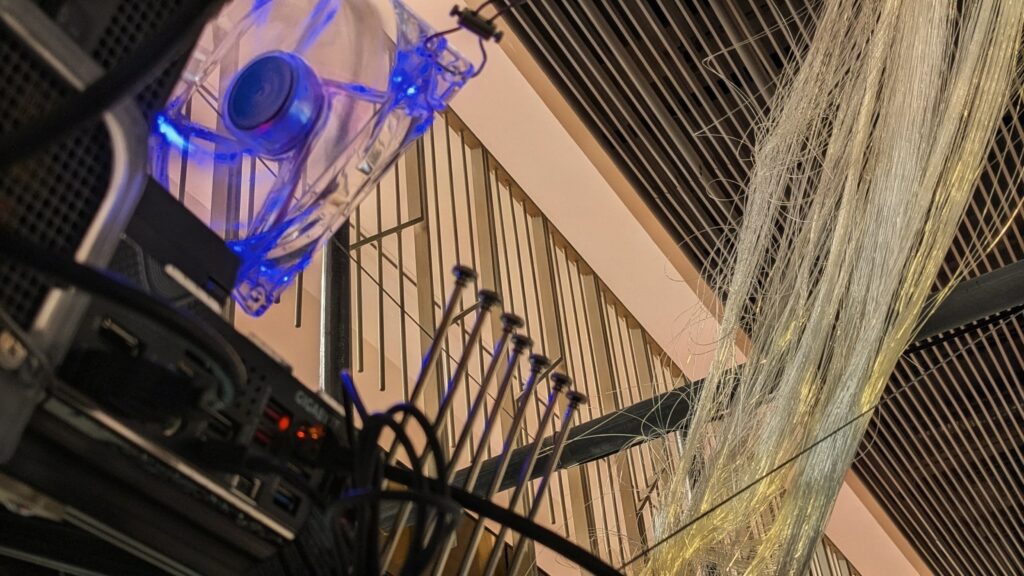
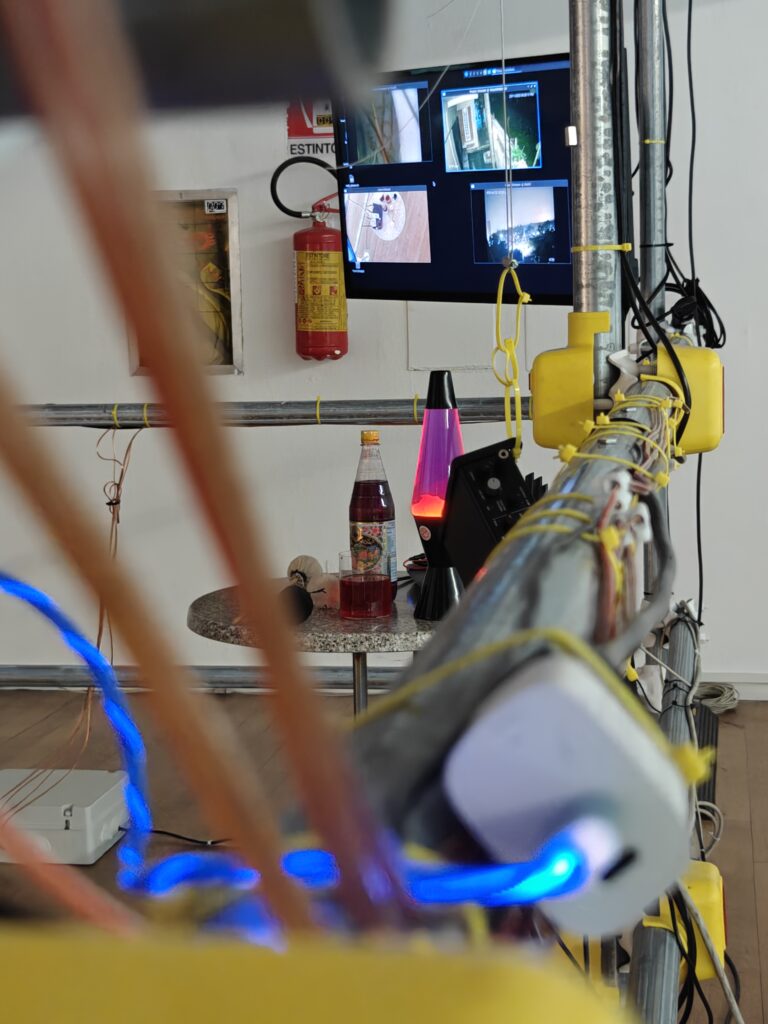
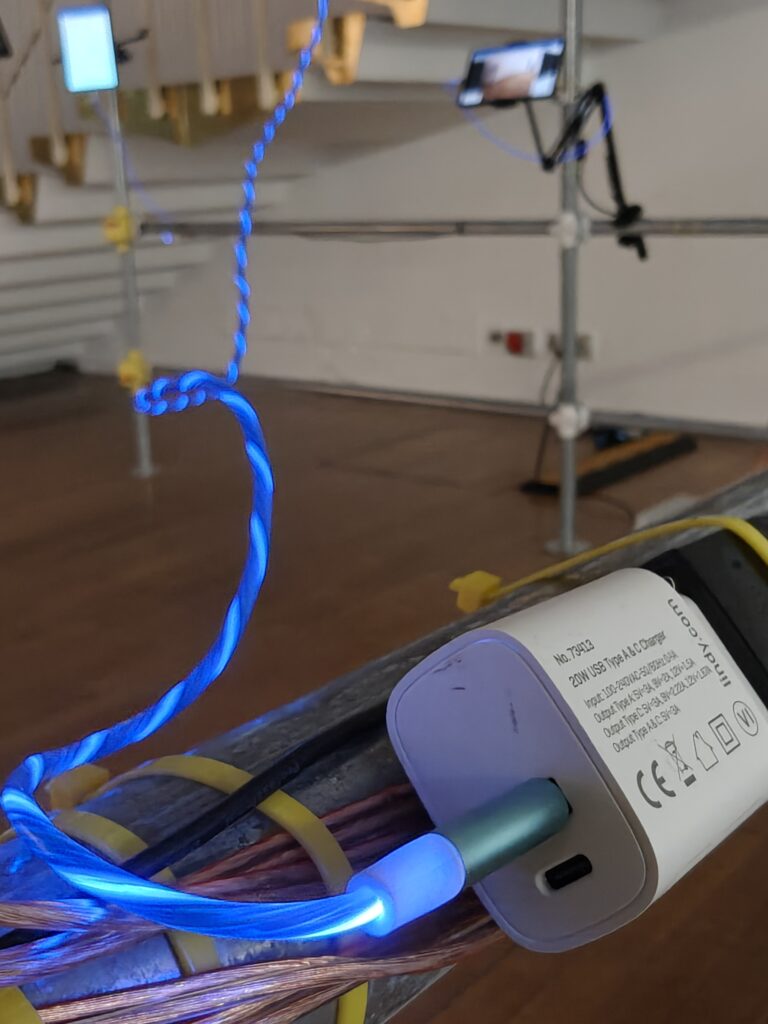
this might not be online is a web of self-hosted servers located in different places and tended by a network of artist milieus. These servers participate in their scenes by becoming part of the infrastructure that carries the chatter of artistic life and experiments in associative densities. Through this process, each has taken on singular embeddings, appearances, and cosmologies –
THE RIVULET
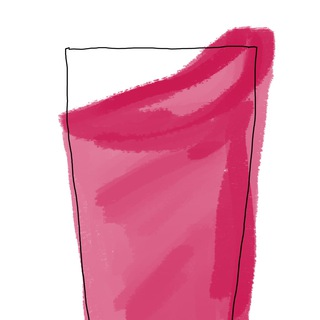
Roohafza is a crimson rivulet. It’s tiny, ephemeral, never still, super sensitive to the terrain, crisscrossing, braiding, distributing itself in surprising ways. Sometimes, it carries a freight train and other times, a garden. Roohafza is hosted at an apartment studio in Jangpura, Delhi. It has been carrying voices, writings, gatherings and web experiments by the associative scene around Delhi since 2022.
THE CATFISH
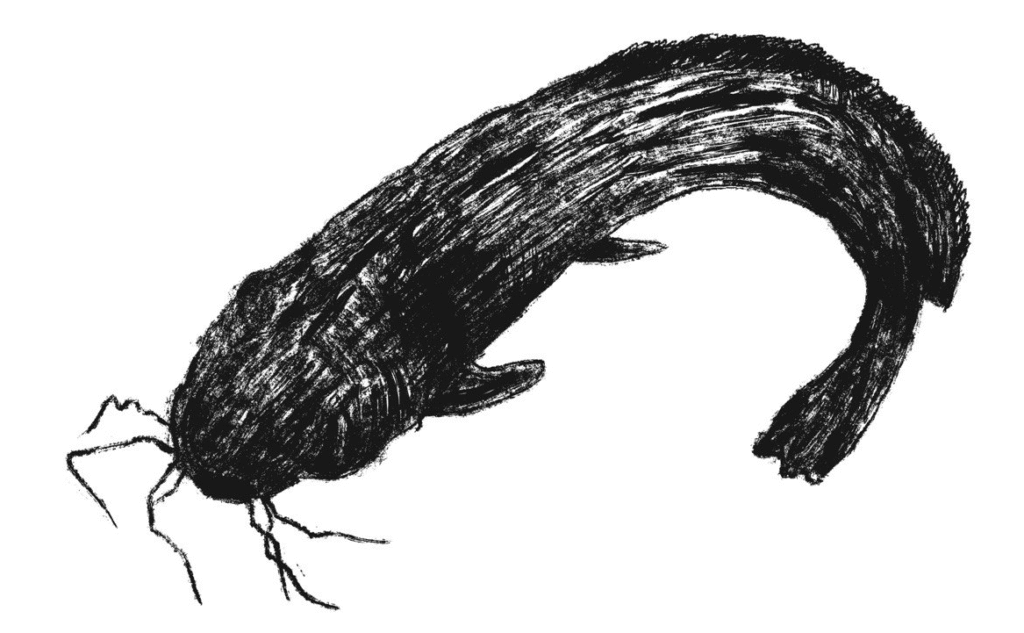
Kaari the catfish is the server in Kochi. Kaari senses the world through chemoreceptors on its skin like a living tongue. It produces minor earthquakes when it flaps its tail in the muddy waters. A gathering of kaari is called kaari koottam, a gathering of loose tongues. At dusk you can hear them jumping in and out of the stream, silver flashes in the corner of the eye. There is a house next to the stream. There is a messy table inside the house with an overflowing ashtray, a half finished drawing, some crayons, an iPad, many glasses that are periodically and magically getting refilled with palm toddy. There is a huddle of bodies around the table, and there are conversations that are being livestreamed on Kaari the server.
THE MEGAPHONE
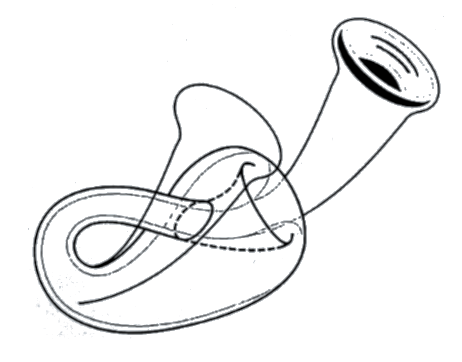
The large aluminium megaphone horn twisting upon itself, amplifying, distorting, reverberating through poppy fields around Shantiniketan is called Chonga. A collective loud mouth. A reorganization of air. A summons. A call to gather from a lowland hollow.
chonga is running since 2025 from GABAA collective’s studio media lab in Shantiniketan, West Bengal. It hosts the collective’s activities in the neighbourhood through videos and livestreams.
this might not be online is conceptualised by Kaushal Sapre, commissioned for ‘India. Of Glimmers and Getaways’, curated by Ferran Barenblit and Raqs Media Collective, PAC-Padiglione d’Arte Contemporanea, Milan, IT.
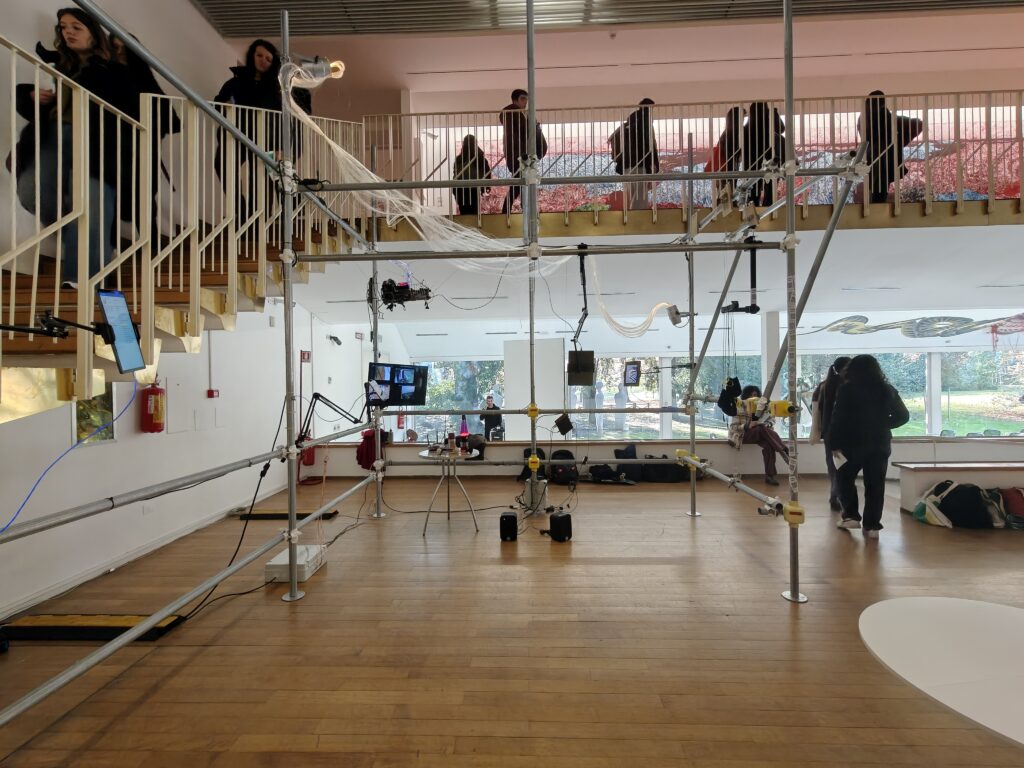
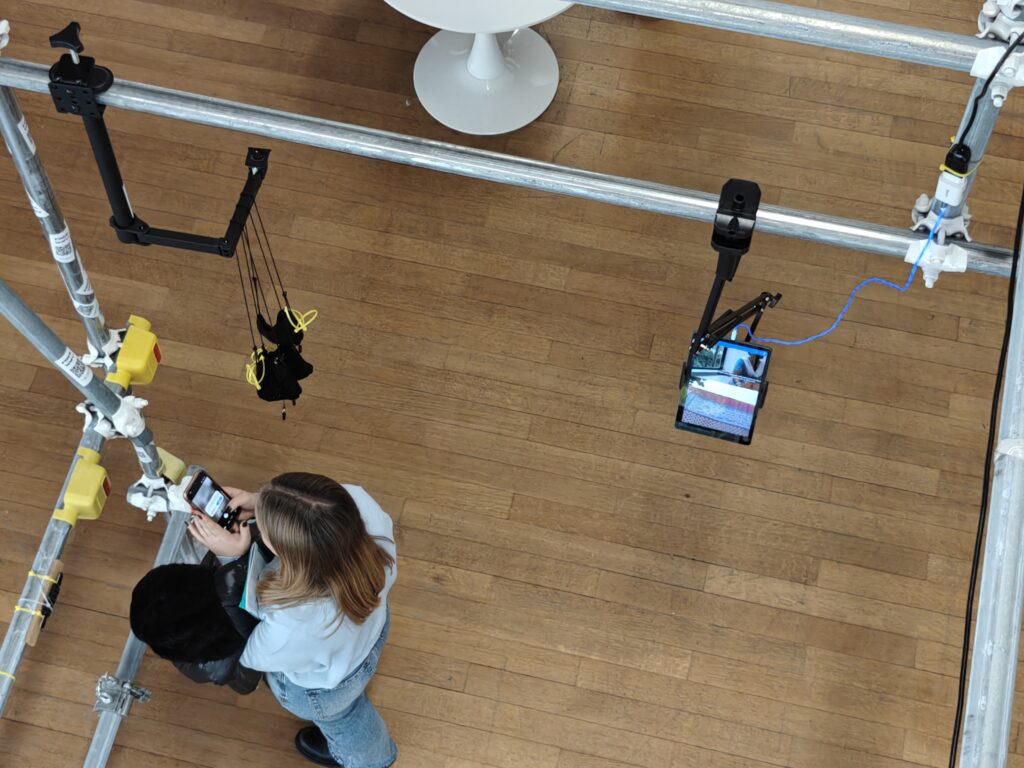
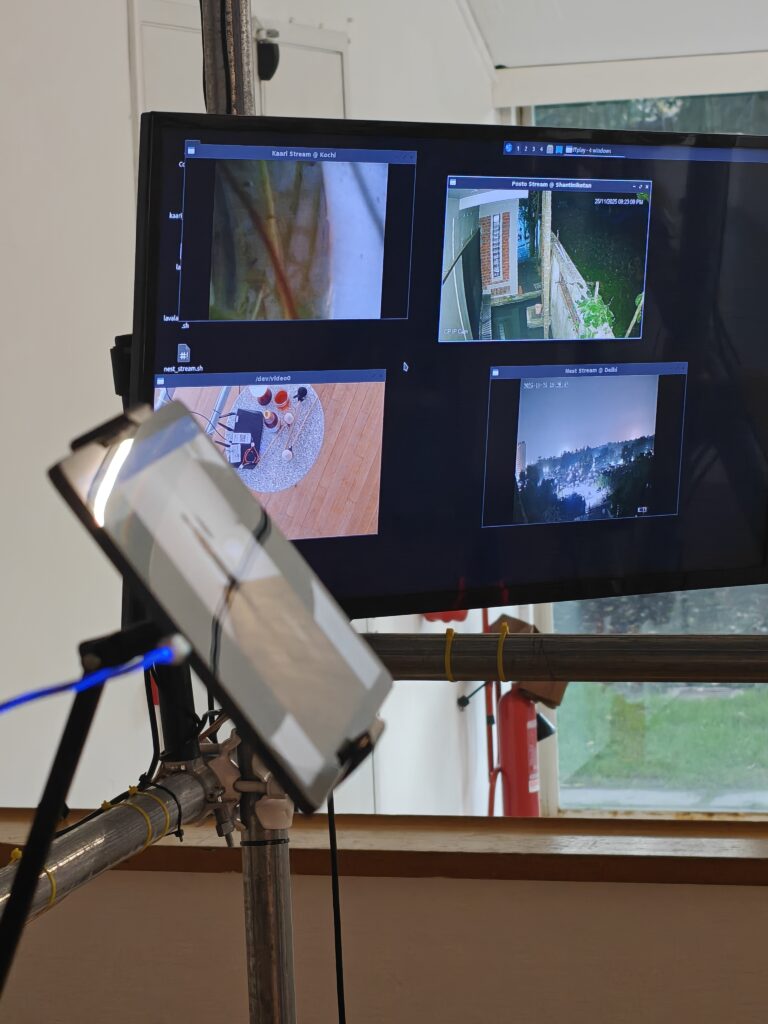
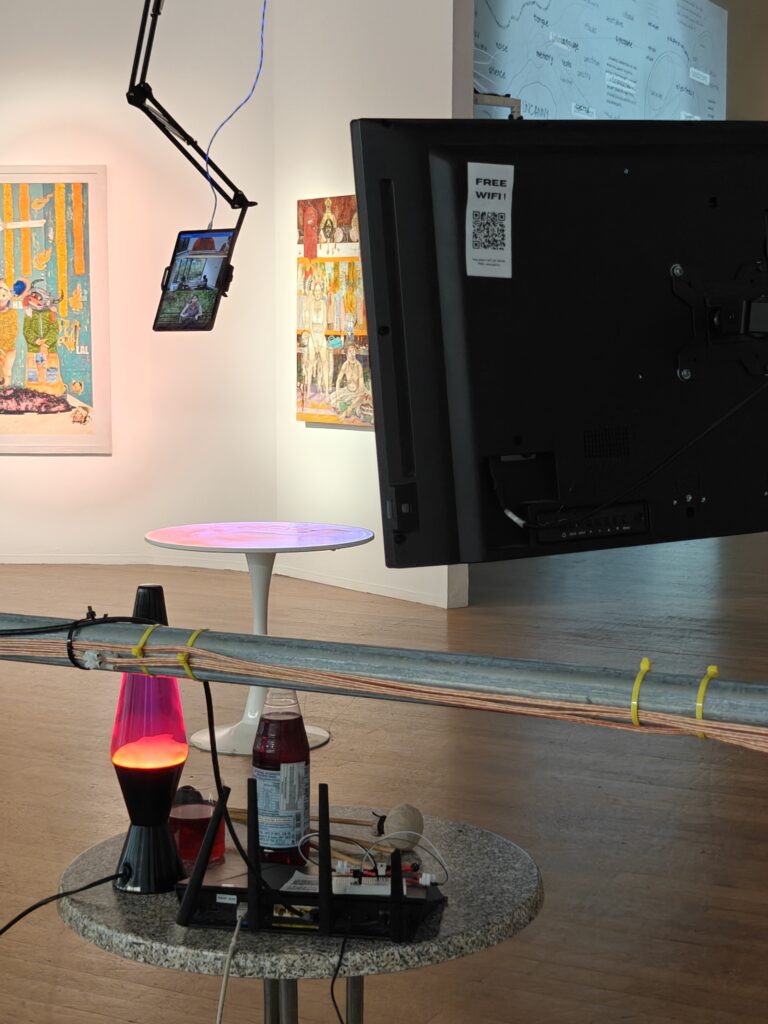
PROJECT NOTES
Keywords:
Scene
- ‘To bring in a relationship of proximity that which is kept over an unbridgeable distance.’(Raqs). Scenes are diagrams of relations between elements and therefore can be described topologically. Scenes have rhythms, flows and interfaces. Multiple scenes are always already happening next to each other in the same place at the same time, often mutually clueless of each other’s existence. Scenes nourish artists.
Confidence
- Confidence is needed to be curious, to explore the world, make bets, take chances. Confidence not as an individual’s psychic trait, but a collective affordance contingent upon infra-structures of the field.
Chatter
- Chatter is others talking. Chatter flows through scenes and takes its shapes. It is what makes you feel close or far from a scene. It is what colours the scene and gives it vibes. It is what comes before the separation between signal and noise.
Occasion
- Occasions are activations. They are always also occasions for something else – to read, to talk, to listen, to eat, to drink, to be with others. Occasions are occasional, in the sense that they are informal, improvised and impulsive. Like smoke breaks. Occasions dissipate chatter.
Non-equilibrium dynamics
- Real world systems do not naturally evolve towards entropy. Instead, they are porous, dynamic and unstable. In the 1970s, physical chemist Ilya Prigogine demonstrated that far-from-equilibrium thermodynamic systems can spontaneously generate complex order through processes of self-organization. All stability is provisional.
Stream
- Streams are all around us, and we plug in and out of them. They are not objects, but flows. They can carry attention, ideas, materials, affects. Streams need to be driven with confidence.
Root Access/Route Access
- Root permissions are needed to access the internal logic of a system. Route permissions are needed to access flows in and out of a system. Root and route permissions are often taken for granted in current technocratic systems. They have to be brought to the surface.
Lighter Economics
Smokers have a curious relationship with lighters that is not based on possession but on continuous exchange. Every smoker knows that the number of lighters in their house is a variable entity. Some days you find many, other days you have to perform dangerous acrobatics with gas stoves and heating coils. Somehow lighters just turn up in life. Indian cigarette shops have a curious technical hack of tying lighters with a long thread as a way of making them common. If a mathematics of the lighter economy has to be formulated, it must start with a sociality of hosting – The number of lighters in a house is a function of the freedom one has of passing through, passing by, passing along. Lighters don’t turn up in isolated houses.
Merve Ertufan, Mochu and Karatani Kojin are sitting in a dimly lit Berlin bar smoking together. Merve (gin & tonic) and Mochu (Jameson) are rolling their cigarettes with this really thin Damascus rolling paper with beautiful calligraphy that they buy in bulk from Istanbul. Karatani (cosmopolitan) smokes black cigarillos. They’re pulling at threads from Karatani’s work of reframing the materialist history of the world through modes of exchange as opposed to modes of production. Karatani reveals four modes of exchange through which the making of social formations could be apprehended. These four types coexist in all historical configurations but differ only on which of the modes is dominant:
- Mode of Exchange A involves reciprocity through gift and counter-gift, predominant in clans and tribal societies.
- Mode of Exchange B is that of ruling and domination, where a despotic or feudal ruler guarantees protection in exchange of servitude.
- Mode of Exchange C can be characterised by the exchange of commodities that crystallizes in modern societies as global capitalism.
- Karatani then goes on to propose an imaginary Mode of Exchange D which involves ‘a recursive move back to mode A with some additional improvements, or at a higher dimension…’
Mode D is related to the gift economy aspect of clan societies, but at the same time is severed from the trappings of a reciprocal principle that demands, simply by the fact of being born in a place, that in the face of a gift an individual is obligated to offer repayment. Instead, it is premised upon a radical freedom of movement and association, and a disposition towards nomadism. Mode D has appeared sporadically and temporarily through history – particularly in ancient Ionia around the seventh to the sixth centuries BCE – giving rise to a social formation known as Isonomia or no-rule, where individuals were equal precisely by virtue of being free.
The air is thick with smoke, and the game of pool on the side is at its climax. It’s about time to leave. With a last swig of their drink, Merve and Mochu ask about the early days of the spread of the civilian internet in the 1970s and 80s that brought with them the promise of a new sense of freedom through open-source technology and rapid communication. Could this moment have carried a trace of Isonomia? Perhaps, says Karatani, stubbing out his cigar, but it was fleeting. Perhaps the need of the hour is to create a lot of small A-like movements that could spiral outward towards an elusive D. A lot of movements. More movements, more entanglements. Smoke rises to the ceiling and settles on to the already dense cluster of spiderwebs, thickening them even further.
Life of Lines
Looking down from the A-17 terrace in Jangpura, you can see many intertwining lines. A loud honking train passes right underneath the building, and a dense line of people wait for the train to pass in order to cross the tracks to the other side. There is a kite’s nest perched on top of a telephone pole shrouded with thick vines and creepers like a lush green overcoat. Ullu the cat is rolling on the rough terrace floor scratching her back. Karthik KG looks out towards the blinking lights of an airplane as it streaks across the sky and narrates a chance encounter with the philosopher Yuk Hui in a roadside street food stall in Hong Kong. Adjusting his foggy spectacles over a piping hot bowl of stir fry, Yuk Hui started with the idea that the development of technology is the very condition of the disappearance of symbols. The human faculty of symbolizing can only function in relation to nature, while technological systems are based on the control of signals and signs, which is more efficient than symbolic mediations. This contradiction has led to the loss of the capacity to symbolize – to unite that which is at an ungraspable distance – the visible from the invisible, the sacred from the profane, the human from the non-human – of freely making associations between objects, totems, animals, gods, spirits, phenomena. To overcome this contradiction between nature and technics, he proposed the idea of cosmotechnics – technical activities as ways to unify cosmic and moral orders. Such a passing is only possible when an ‘outside’ of the techno-logos is admitted and allows the symbolic to re-emerge from the new constellation.
Karthik has carried back packets of Hunanese cigarettes as gifts for his friends. They have white gold packaging with bright golden borders. A sigil of a hibiscus flower with eight-fold symmetry is embossed on the box. The sun is about to set and the sky has an orange gold tinge that mixes into my crimson drink of roohafza and gin. It’s getting headier, and I’m getting a bit impatient. I’m confused, I tell him. I’ve been thinking a lot about the internet. The internet as a network of computers connected to each other with lines and cables on one hand, and on the other hand as this immaterial, omnipresent thing that so often dictates a common sense of time, space and orientation. I’ve been setting up these self-hosted web servers at friends’ houses. Mostly old laptops or assembled PCs reconfigured to store files and livestream media. I’m trying to think of them as computers that are shared between many people. And then to imagine the internet itself as many many shared computers. But I feel a bit stuck. Where is this ‘outside’ that you speak of, that can imagine cosmotechnics for an internet?
I dunno man, he says. I think it’s not about symbols as mere representation, but more to do with how they shape relations between humans and environments. For example, think of an oriented line – he draws his finger across the dusty edge of the wall – a uni-directional outward movement, or a vector. Like the Great Indian Rope Trick. It’s a diagram of causality with progress understood as a linear pre-defined outcome. In the 90s, with the computer revolution in India, this idea of progress as linearity became embedded in the new middle-class consciousness. I guess we are still contending with it all the time. Or think of another symbolic paradigm – the maze – he draws more invisible lines on the surface of the wall this time, and a faint trace of triangles emerges, folded in on themselves, getting smaller and smaller. Ullu and I are following his finger with our eyes. A non-linear movement with a predefined finality. Structured and repetitive – like a fractal. Every time you make a turn or a choice in a maze, you’re presented with another set of similar choices. Kind of Kafkaesque, no? The server is quite an exemplary technical object of our time. At industrial scale, each individuation of the server comes with its own cosmology. Server farms are settler-agrarian. Data bunkers sit within a cosmos of war. Cloud storage stages an immateriality, a weightlessness, a universal transcendence. So I guess I’m curious about the worlds that are being built around your servers. What are your servers like?